Mergers and acquisitions can be defining moments in a business’s growth. But for many companies, the experience is far from straightforward. Behind the planning and negotiations, there are people, customers and relationships that need attention and care.
Over the years, we’ve supported a number of businesses through the merger process. One thing that stands out is how often brand is treated as a secondary concern. In reality, it plays a critical role in shaping the outcome. A clear brand strategy helps businesses navigate uncertainty, align teams and protect what matters.
Here, we look at some of the key challenges faced during mergers and acquisitions, and how a strategic approach to brand can help make sense of it all.
Merging cultures, not just businesses
Bringing two organisations together means merging more than just operations. Each side has its own ways of working, values and internal dynamics. When culture is left unchecked, tension often builds beneath the surface.
This is one of the most common issues we come across. Employees may feel disconnected. Communication becomes inconsistent. Decisions start to pull in different directions.
According to McKinsey, 44% of failed integrations are attributed to a lack of cultural alignment¹. It’s a factor often recognised too late. A shared brand framework gives teams something to rally around. It helps people understand the purpose behind the merger and the values guiding it. More importantly, it creates the conditions for a new culture to take shape.
In our work with Vibrantz, a global manufacturer formed by the merger of three legacy companies, we helped define a brand that captured the purpose of the new organisation while honouring the strengths of each business. This kind of brand clarity helped bridge cultural differences from the outset.
Communication that builds confidence
In the middle of an acquisition, it’s easy to deprioritise communication. But silence rarely brings calm. When people don’t know what’s happening, they fill the gaps themselves.
We’ve worked with clients to shape communications that are timely, honest and clear. That might mean internal briefings that explain the process, external messaging to reassure customers, or simply a consistent tone across all touchpoints.
Research shows that companies who manage communication well during M&A are 50% more likely to achieve their expected synergy targets². A considered approach doesn’t just inform—it builds trust and reinforces the idea that the business is moving with purpose.
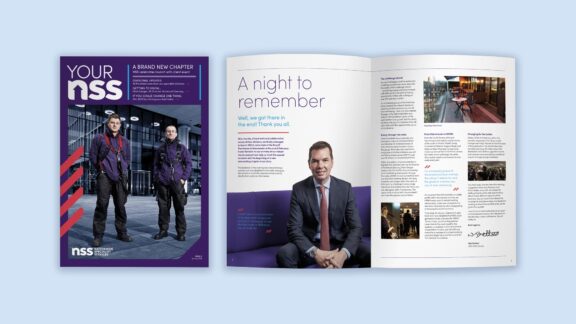
At NSS, a facilities management group, we supported the brand through a multi-business merger. The leadership described our support as helping them “plot a smooth course” through complexity, with a focus on clarity and rapid decision-making.
Supporting the people behind the business
People are often at the heart of the business. During a merger, uncertainty around roles, direction or leadership can lead to concern. In some cases, businesses risk losing key individuals.
Studies show that one-third of employees at acquired companies leave within the first year post-acquisition³. That level of attrition can be particularly damaging for smaller businesses.
We’ve supported leadership teams in communicating change in a way that helps people feel part of what’s next. A strong internal brand can make the transition feel like a shared journey, not a disruption. That’s why brand strategy for mergers and acquisitions matters, it gives people clarity and helps them see where they fit in the future of the business.
Following its rebrand, BGEN reported a 20% increase in its workforce alongside major contract wins. Its CEO credits the clarity of brand strategy with helping attract new talent and communicate a refreshed sense of purpose.
Maintaining customer relationships
While leadership teams focus on integration, customers are often left to wonder what the changes mean for them. Familiar names and services may shift. Pricing, processes or points of contact can change.
Harvard research highlights that customer satisfaction typically drops by around 3% in the two years following an acquisition⁴. This is often driven by a loss of brand consistency or changes to service experience.
If not handled carefully, this can erode long-standing trust. We’ve worked with businesses to manage this shift in a way that feels transparent and reassuring. Whether through customer-focused messaging, a refreshed brand identity or small but meaningful updates to the service experience, the goal is the same: consistency and clarity.
In our work with Visku, a new brand formed from the merger of two supply chain consultancies, early attention to brand positioning helped customers and staff understand what the new business stood for, and why it mattered.

Deciding what to keep and what to evolve
One of the most sensitive questions in any merger is what happens to the brand itself. Do you keep the name? Change it? Combine elements of both? A good brand strategy for mergers and acquisitions can help answer these questions.
There’s no one-size-fits-all answer. But there is a process. We’ve helped businesses weigh up the implications of each option through research, stakeholder input and strategic planning.
Some decisions are emotional. Others are commercial. A clear approach to brand architecture brings structure to what can otherwise feel like a difficult or subjective choice.
Protecting brand equity during change
Brands carry value. They represent reputation, customer loyalty and hard-won positioning. During a merger, that value is at risk.
Intangible assets such as brand and reputation now make up more than 80% of total deal value in many acquisitions⁵. That figure alone highlights the need to preserve and actively manage brand equity during integration.
We’ve seen how inconsistency across visual identity, messaging or service standards can create confusion. But we’ve also seen how a joined-up brand approach can strengthen relationships, build market presence and act as a steady hand through transition.
This kind of thinking starts early. The sooner the brand experience is considered part of the integration plan, the more resilient the business becomes.
Staying focused when everything is shifting
For many business leaders, a merger is unfamiliar territory. While navigating legal, operational and financial demands, it’s easy to lose sight of the day-to-day.
We’ve supported clients in keeping their brand strategy front and centre. It acts as a guidepost, helping prioritise what matters and avoid being pulled in too many directions.
In this context, brand isn’t just a communications tool. It’s a lens through which to make decisions, align teams and stay connected to your purpose.
Planning for what happens next
Mergers are often seen as an endpoint. In reality, they’re the beginning of a new chapter. What happens after the deal completes determines whether the merger delivers long-term value.
We’ve worked with clients well beyond the point of transition, helping them evolve the brand over time, embed new behaviours and respond to ongoing change.
A strong brand strategy gives structure to this process. It supports consistency, fosters engagement and helps the business grow into its new identity with confidence.
If your business is navigating a merger or acquisition, you’ll know it’s not a straightforward path. But with a clear sense of identity, a joined-up approach to communication and a brand that reflects your ambition, it becomes easier to manage the journey ahead.
Explore more about our brand strategy approach, or take a look at how we’ve helped other businesses adapt, grow and evolve with confidence in our case studies.
References
- McKinsey & Company, “Why culture is so often the forgotten element in M&A,” 2023
- PwC, “Creating value beyond the deal,” 2020
- Deloitte, “M&A Trends Report,” 2022
- Harvard Business Review, “Customer Satisfaction After Mergers,” 2020
- Ocean Tomo, “Intangible Asset Market Value Study,” 2020