The development of AI tools is accelerating and the pace feels relentless. Keeping up with the latest platforms, trends and ways to take advantage of them can quickly become a full-time job.
For start-ups, it’s never been easier to bring a new business idea to life, with the temptation to do almost everything alone. It’s an opportunity for the Davids of this world to take on the Goliaths.
But making something is not the same as building something distinctive.
There are no shortcuts to brands that connect on a human level
The promise of AI helping to create your logo, brand identity and messaging in just a few short prompts certainly sounds enticing, particularly for start-ups where funds are tight.
In the early days, the results rarely matched that promise. As the technology advances, though, the gap is closing quickly.
Image generation has come a long way and, mostly, people now have the right number of fingers! – although there are still many embarrassing AI image mistakes in circulation. The ability to ‘spot the difference’ between AI-generated imagery and real life is becoming much harder.
Only recently, I was sent an image of a Twin Towers drone memorial and initially dismissed it as fake. It was real, and incredibly impactful and considered. The kind of moment that stays with the people who witness it.
And I think that’s part of the problem.
When almost anything can be fabricated convincingly with very little effort, genuine moments of surprise start to become harder to recognise. When everything is dialled up to 100, cutting through takes something more than an algorithm responding to a prompt.
It takes a point of view.
A real brand strategy has to be lived
A strong brand is built in reality. It’s how your company acts, behaves and expresses the values it genuinely holds.
Sure, those things might need shaping. You may need greater clarity so everyone can align around them. They may also need to evolve as the company grows. Few businesses stay exactly the same forever.
But if the essence of your brand isn’t true to who you are as a company, it will never fulfil its potential. Worse still, your customers are unlikely to believe it or remember it either.
That’s why a clear brand positioning strategy matters. You need something different to say, and that point of difference needs to come from a genuine truth about your organisation, your customers or the way you see the world.
Not something simply plucked from an LLM because it sounds plausible.
Having the branding expertise to know what good looks like
A brand created using AI isn’t necessarily flawed.
But shaping the strategy, messaging, colour, typography, imagery, motion and wider experience takes careful consideration and years of experience.
AI is ultimately a tool. It will respond to the direction you give it and, more often than not, try to satisfy the brief. Give it the wrong brief and it can confidently produce something that heads in completely the wrong direction.
Ask it afterwards to critique what it created, and it will probably find plenty of faults too.
That’s where experience becomes important.
Knowing how to shape the brief, identify the right questions, challenge assumptions and critique the outputs is what turns the tool into something genuinely useful. We’ve explored this in more detail before when asking whether you can trust AI to build your brand.
I think this simple experiment proves the point rather nicely.
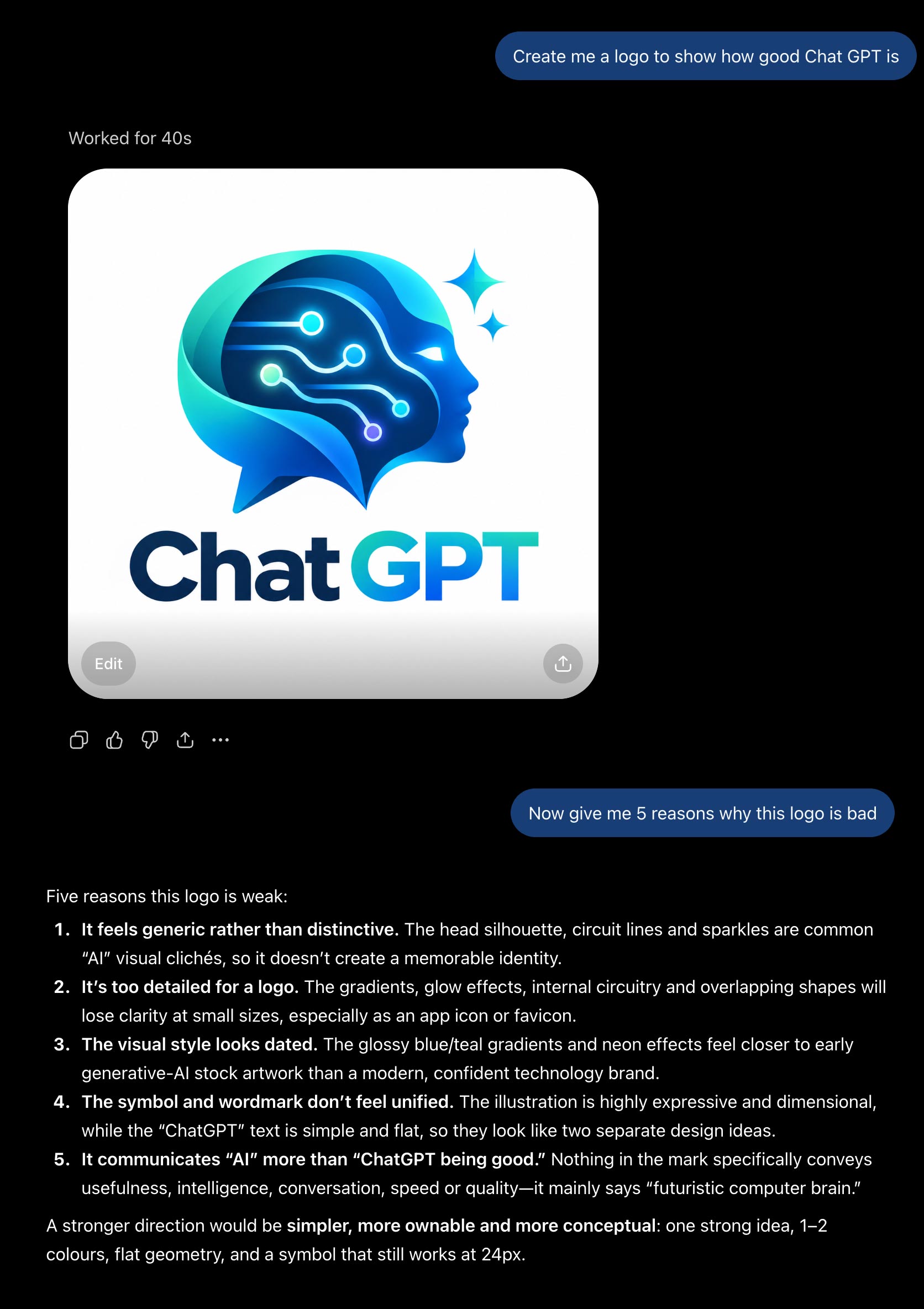
Ask AI to create a logo that demonstrates how good AI is and it can produce one almost instantly.
Ask it what’s wrong with that same logo and it can also tell you that it’s generic, over-detailed, visually dated and reliant on familiar AI clichés.
The issue isn’t its ability to create.
It’s knowing what should have been created in the first place.
Building a strong brand foundation is essential to consistency
There’s no doubt AI can help speed up lots of processes. It has certainly helped us research markets, explore competitors and understand the brands we work with in ways that some budgets wouldn’t previously have allowed.
We’ve also used it to support creative exploration and remove repetitive tasks from the process, which we’ve written about in how we’re using AI to enhance creativity at Studio North.
And when you have a strong design system, automation can be incredibly useful. Repetitive production can happen more quickly and with greater consistency.
You see this particularly in digital platforms, where large SaaS companies use carefully constructed design systems to roll out changes across sprawling websites and products.
But that initial foundation still needs thought, craft and refinement.
Get the building blocks right and you have something distinctive and ownable that can scale.
Get them wrong and you’re simply scaling sameness.
The risk of taking the path most travelled
AI naturally looks for patterns.
Ask it to build a website and it may choose an established framework such as Tailwind as its starting point. There’s nothing inherently wrong with that. Bootstrap and countless other frameworks have helped designers and developers work more efficiently for years.
The important part is what happens next.
It’s the tailoring, judgement and craft applied to that foundation that makes one brand feel different from another. Without that extra effort, defaults continue to look like defaults.
And without the know-how to move beyond them, the outcome can easily become uninspiring or indistinguishable from everyone else in the category.
In some corners of the influencer world, there are more questionable tactics being promoted as the best way to get results from AI website builders. Often this involves feeding tools exact references or carefully shared prompts designed to reproduce an existing aesthetic.
The outcome is predictable. You either get something close to what was supplied or another variation of the same templated approach.
At best, you end up looking like your competitors.
At worst, you’re creating something uncomfortably close to somebody else’s brand.
Distinctiveness still needs human judgement
The brands that break through aren’t simply the ones producing the most content, the slickest AI imagery or the fastest website.
They’re the ones that know who they are.
A useful example from our own work is Era4, an AI infrastructure business operating in a category where much of the language and visual expression was becoming increasingly similar. Rather than leaning further into generic technology cues, the strategy focused on creating a clearer and more credible position that the business could genuinely own.
That’s the opportunity AI makes even more important.
As the tools make competent execution available to almost everyone, the advantage shifts further towards clarity, originality and judgement.
The brands that win are the brands that are true to themselves
We’re not saying a brand can’t start life through a prompt.
But every prompt you make and every output you review needs consideration. Ideally, it needs someone with the expertise to pick it apart, challenge it and decide whether it’s genuinely fit for purpose.
Most importantly, make sure your brand remains true to who you are and is designed to deliver the results, growth or change you expect from it.
AI can help you get somewhere faster.
But speed means very little if you’re heading in the same direction as everybody else.
A strong brand still needs to be distinctive, memorable and trusted. It needs an idea people can believe in and a point of view they can recognise as yours.
There are rarely shortcuts that beat experience.
That’s why we let our clients be the experts in their field, while we help them thrive by being experts in ours.