The hidden risk of growth
Most businesses don’t stand still. They grow. They evolve. They expand into new markets. They refine their offer or grow through acquisition.
From the outside, this all looks like great progress. But from the inside, it often feels more complicated.
Because while the business evolves, the brand often doesn’t keep pace.
What once felt clear becomes harder to explain. What once differentiated the organisation now starts to blur.
This is the repositioning gap.
And if left unchecked, it quietly slows growth.
What is the repositioning gap?
The repositioning gap is the distance between:
- what your business has become
- and how your brand is still being presented
It shows up as inconsistent messaging and outdated brand identity that no longer reflects what the business has become.
At first, the gap is small:
Your messaging feels slightly dated.
Your value proposition doesn’t quite land.
Your teams explain the business in slightly different ways.
But over time, that gap widens. And what was once a strong, clear brand identity and message becomes fragmented.
Why it happens
The repositioning gap isn’t a failure, it’s a natural consequence of growth, and many businesses evolve faster than their brand strategy.
Common triggers include:
- responding to competitive disruption
- entering new markets
- a shift in your product or service offer
- adapting to change following a merger or acquisition
Each of these fundamentally changes the business. But unless the brand evolves alongside it, the external story stays behind.
The symptoms you can’t ignore
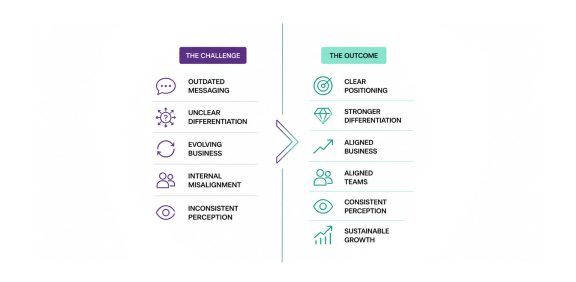
The repositioning gap rarely shows up as a single problem, but you’ll recognise it when:
- your differentiation is weak or unclear
- leadership struggles to articulate the brand story
- your messaging feels outdated
- different teams describe the business differently
- the market perception doesn’t reflect your ambition
None of these feel catastrophic on their own. But together, they slow momentum.
Why this matters commercially
It’s easy to underestimate the impact of brand misalignment. After all, the business is still operating. Revenue is still coming in. But a lack of clarity creates hidden inefficiencies:
Sales becomes harder than it should be.
Marketing loses impact.
Opportunities take longer to convert.
Differentiation becomes price-led rather than value-led.
In short, you end up working harder for the same results, and you’re left thinking…
“No one knows quite what our brand stands for, or where it’s going”.
What strategic repositioning really means
Repositioning isn’t about changing how your brand looks. It’s about redefining what your brand means.
At its core, it’s about clarity.
Clarity around:
- what your business stands for
- what you want the business to be known for
- where it sits in the market
- what makes it different
- how it should be communicated
Brands that do this well feel simple, but that simplicity is hard-won.
The four pillars of effective repositioning
Successful repositioning typically focuses on four areas:
1. Strategic positioning
- Defining the space your brand should own.
2. Value proposition
- Clarifying the real value you deliver to customers.
3. Brand narrative
- Creating a clear, compelling story of who you are now.
4. Messaging frameworks
- Ensuring consistency across every touchpoint.
Together, these create a coherent system.
The impact of getting it right
When repositioning is done well, the shift is immediate.
Leaders speak with clarity.
Teams align behind a shared direction.
Customers understand your value faster.
Sales conversations simplify.
Marketing becomes more effective.
Differentiation becomes stronger. The business gains momentum.
Clarity for your brand is not optional
Businesses evolve, that’s inevitable – but clarity doesn’t happen by accident. It has to be designed.
If your brand no longer reflects the business you’ve become, it’s not just a branding issue – it’s a strategic one.
And it’s a signal.
A signal that you’ve reached a breakthrough moment.